2026-10-24 ·
How Holladay's Winter Inversions Trap Dust in Air Ducts
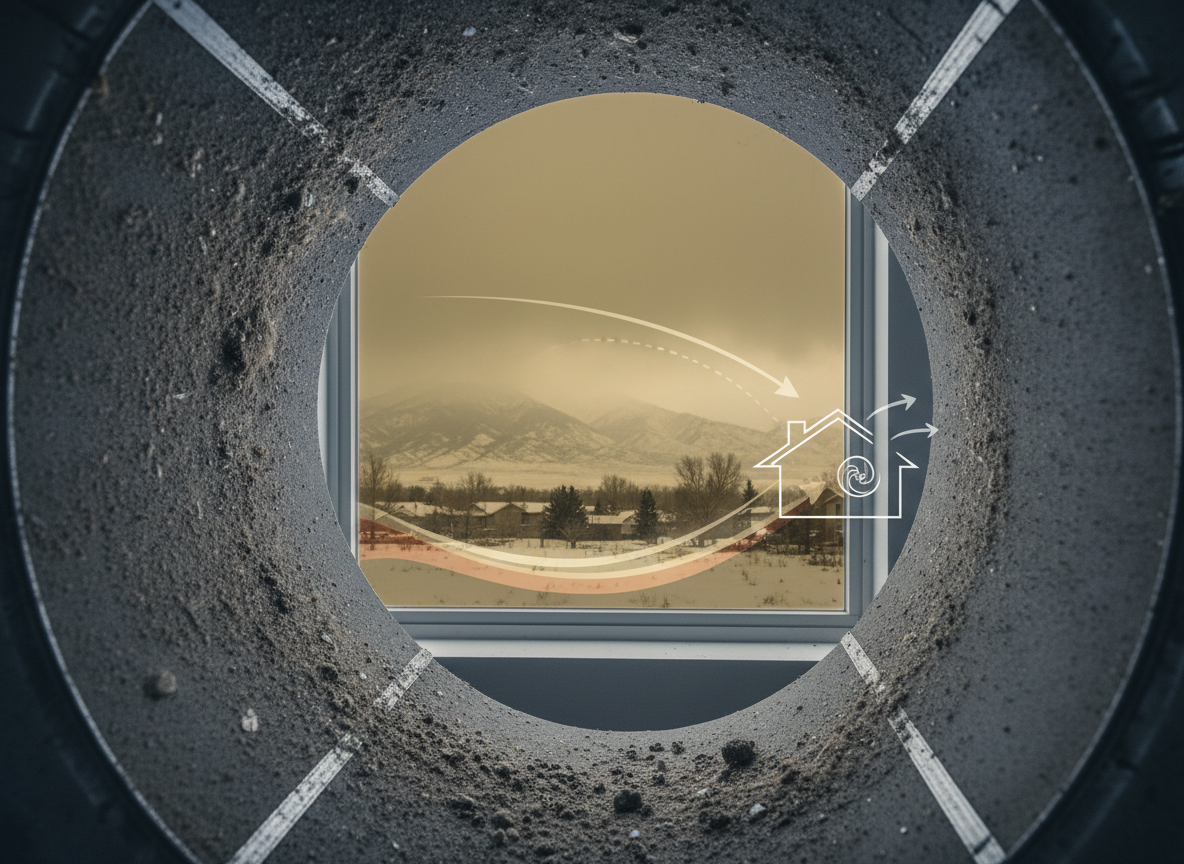
Holladay winter inversions trap dust in air ducts when a layer of warmer air sits above colder ground-level air, often lasting 3 to 10 days and preventing normal dispersion of fine particles from roads, fireplaces, and dry soil in Salt Lake County.
The Science of Inversions in the Salt Lake Valley
Semi-arid conditions with cold snowy winters set up strong temperature gradients once snow covers the ground and high pressure settles over the Wasatch Front. Cold air drains into the valley from surrounding mountains while a cap of warmer air forms aloft, often between 1,000 and 3,000 feet. This stable layer stops vertical mixing, so dust from Cottonwood Heights roads, construction in Millcreek, and wood smoke in Salt Lake City remains suspended near homes. In Holladay the effect is pronounced because the bench topography funnels cold air into lower pockets near Holladay City Park and Olympus Hills Park. Residents notice the haze lingers longest in December through February when daytime highs stay below freezing.
How Dust Accumulates in Ducts During Inversions
Forced-air furnaces run longer during inversion events to maintain indoor comfort, creating negative pressure that draws outside air through every small leak in the building envelope. Fine particulates smaller than 10 microns settle on registers, inside return ducts, and on furnace filters at rates that can double normal winter accumulation. In older Holladay homes with 8- to 12-inch metal ducts, the low-velocity air in long horizontal runs lets particles drop out before reaching the filter. Over multiple inversion cycles the layer thickens, reducing airflow and forcing the blower to work harder. The same pattern repeats in Mount Olympus and Cottonwood Heights where many homes sit on slopes that experience the inversion lid most consistently.
Specific Challenges in Holladay Neighborhoods
Homes in Holladay Village and Mount Olympus often feature multi-level layouts with ducts routed through unconditioned attics and crawl spaces that stay colder than living areas during inversions. Cold surfaces inside those ducts promote condensation when warmer indoor air mixes in, turning dry dust into a sticky film that clings to metal. Nearby cities such as Millcreek and Cottonwood Heights share the same valley air mass, so particles generated there travel into Holladay systems on the rare light winds that still occur under the inversion. Property owners along Highland Drive report visible dust rings around floor registers within a week of an inversion starting, especially in homes built before 1990 with original ductwork.
Practical Steps for Homeowners
Check filters every 10 to 14 days once inversion forecasts appear on local weather reports and replace them when the pleats darken. Keep supply and return vents unobstructed so the system does not pull harder against the restriction. Schedule furnace and duct cleaning after the last major inversion of the season rather than during it, because disturbing settled dust while the lid is still in place can redistribute particles indoors. Residents in Mount Olympus often combine this work with what influences air duct cleaning prices in Holladay homes to understand how duct length and access points affect the job. The same inversion-driven dust also sets the stage for later wildfire smoke issues addressed in related seasonal planning.