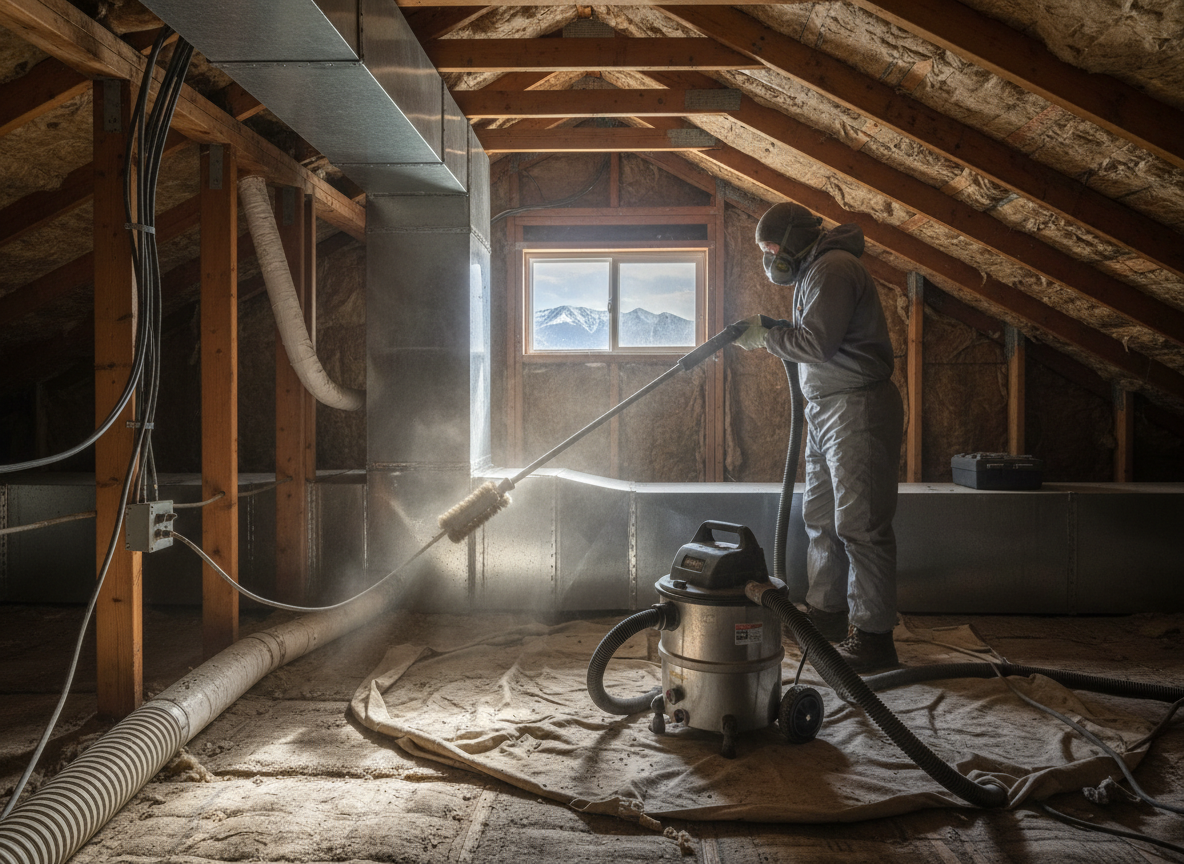
Holladay homes in neighborhoods like Mount Olympus and Cottonwood often feature older ductwork running through attics and crawlspaces that collect fine dust during the hot, dry summers. When winter temperatures drop and furnaces run continuously, that accumulated material gets pushed through the entire system. Metal ducts common in Salt Lake County houses from the 1960s onward can develop seams that loosen over decades, allowing debris to settle in hard-to-reach elbows and transitions near Holladay City Park and Olympus Hills Park.
Technicians must account for the hilly terrain around Mount Olympus when setting up equipment, because negative-pressure machines need stable placement on uneven driveways or side yards. In semi-arid conditions, low humidity reduces mold risk but increases static that holds dust to duct walls. Homes in Millcreek and Cottonwood Heights nearby show similar patterns where tree pollen from summer infiltrates unsealed returns, requiring careful agitation before vacuuming to avoid pushing particles deeper into branch lines.
Edge cases include ranch-style houses in Holladay Village where ducts run under slabs, limiting access points without cutting into finished ceilings. Always verify that registers and dampers are fully functional before starting, as winter heating cycles can warp older plastic components. Skipping this step often leads to uneven airflow after cleaning and repeat calls from homeowners in the area.
Proper technique involves isolating each trunk line and using forward-facing brushes sized to the duct diameter rather than generic whips that miss corners. This matters more in Salt Lake County homes where long runs feed multiple stories and any missed debris recirculates for months.
Technician insight
In Holladay, the thing that catches most people out with HVAC duct cleaning is how cold snowy winters force nonstop furnace operation that drives fine summer dust deep into seams of older metal ducts, especially in Mount Olympus homes built on slopes where attic access is limited and long trunk lines feed multiple levels.
Mount Olympus Home After Winter
Homeowner reported weak airflow from several vents following months of heating. Inspection showed heavy dust layers in attic runs feeding the upper floor. Technicians isolated the main trunk, agitated each branch line, and extracted the buildup without disturbing insulation. Airflow returned evenly across all registers.
How it works
- 1
Initial System Inspection
Map all supply and return runs, note access points, and check for damaged sections common in older Holladay homes.
- 2
Equipment Setup
Place negative-pressure vacuum at the main trunk and seal registers to contain debris during agitation.
- 3
Agitation and Extraction
Run rotating brushes through each line while the vacuum pulls material out, focusing on seams and elbows affected by winter furnace cycles.
- 4
Final Verification
Reopen the system, confirm airflow at every register, and document before-and-after conditions for the homeowner.
Pricing
Pricing varies by number of runs, access difficulty in older homes, and whether slab or attic work is required; upfront quote provided after inspection.