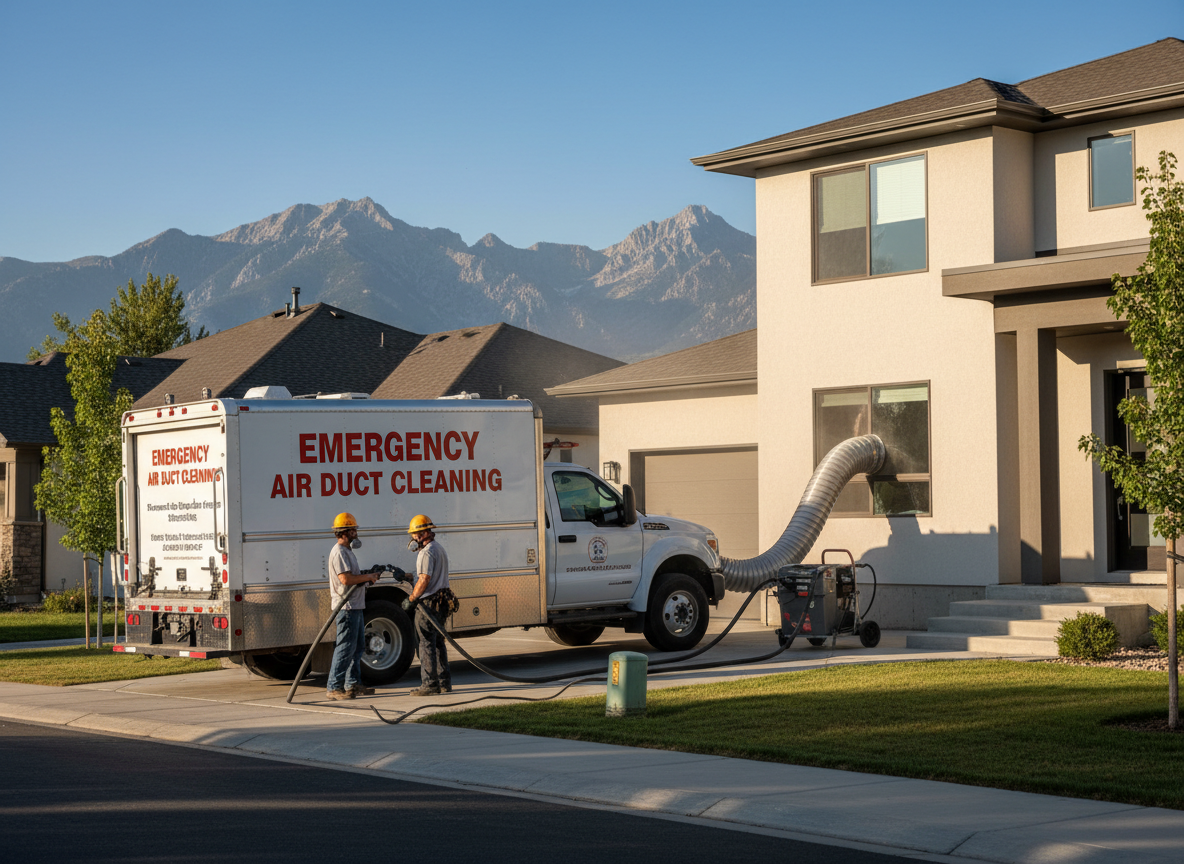
Holladay's semi-arid climate brings hot summers that push cooling systems hard and cold snowy winters that force furnaces to run nonstop, trapping pollen, fine dust, and insulation fibers inside ducts. Homes in Holladay Village and near Olympus Hills Park often date to the 1960s through 1980s with original metal ductwork routed through crawl spaces or attics that collect rodent debris and construction dust from nearby rebuilds in Cottonwood. When airflow suddenly drops or odors appear, technicians must isolate the affected trunk lines quickly before the issue spreads to the rest of the Salt Lake County house.
Emergency calls frequently involve pet dander or smoke infiltration after winter storms keep windows sealed for weeks. Mount Olympus terrain means some homes sit on slopes where negative pressure from downhill winds can pull outside contaminants inward through unsealed joints. Crews use HEPA-filtered negative-air machines and rotary brushes sized for 6-inch to 12-inch rigid ducts common in Millcreek and Cottonwood Heights border properties, taking care not to damage older fiberglass-lined sections that can shed particles when disturbed.
Access challenges appear in split-level homes around Holladay City Park where ducts run under finished basements or through tight chases. Technicians first map the system with cameras to locate blockages, then perform source removal before any sanitizing step. This prevents pushing debris deeper into branches that serve bedrooms, a common mistake when homeowners attempt DIY vacuuming during a sudden heating failure.
Technician insight
In Holladay, the thing that catches most people out with Emergency Air Duct Cleaning is how quickly winter snow and constant furnace use pack fine dust into the older flex and rigid ducts common in Mount Olympus homes; the slope terrain also creates hidden low spots where debris settles and blocks airflow faster than flat lots in Salt Lake City.
Sudden Heating Loss After First Snow
A family in a 1970s split-level near Olympus Hills Park lost airflow to upstairs bedrooms after the first heavy snow. Camera inspection showed packed dust and insulation fibers blocking the main trunk feeding the second floor. Crews isolated the line, performed source removal through existing access points, and restored full airflow the same evening without opening walls.
How it works
- 1
Initial Assessment
Technician arrives within hours, inspects registers and returns, and uses a camera to identify the blockage or contamination source in the Holladay home.
- 2
Containment Setup
Negative-air machines and sealed barriers isolate the duct system to prevent dust migration into living spaces during cleaning.
- 3
Source Removal
Rotary brushes and compressed air clear debris from trunk and branch lines, focusing on areas affected by winter furnace use or summer cooling cycles.
- 4
Final Verification
Post-clean camera inspection confirms clear ducts, followed by register cleaning and system airflow testing before departure.
Pricing
Upfront quotes based on system size, number of runs, and access difficulty; emergency rates apply outside standard hours.