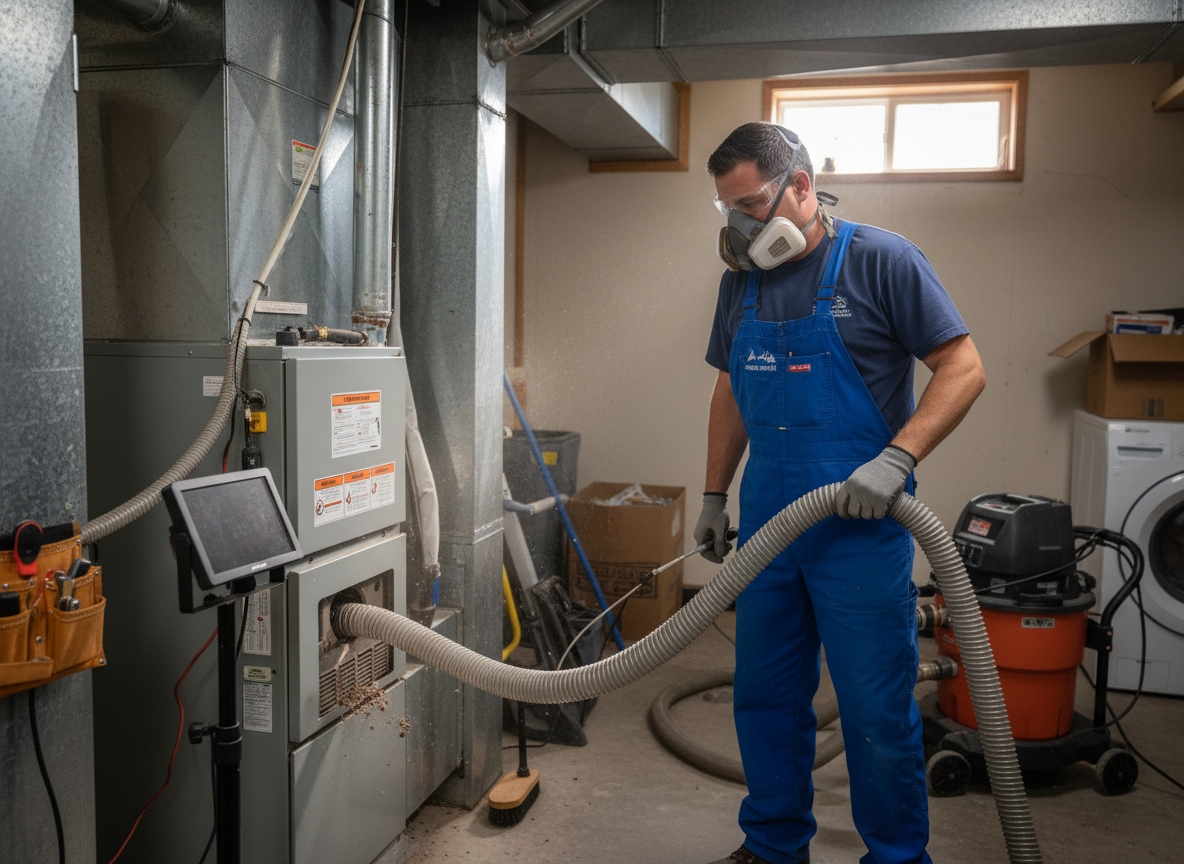
Holladay homes built in the 1960s through 1980s around Holladay Village and Mount Olympus often have rigid metal duct runs that collect fine silt from the semi-arid climate. Hot summers drive air conditioning use that pulls pollen through return vents, while cold snowy winters force furnaces to run for months, pushing that same material deeper into supply lines. Technicians at 5025 Highland Dr routinely pull out layers of dust mixed with cottonwood fluff from trees near Olympus Hills Park before it recirculates into living spaces in Cottonwood Heights and Millcreek.
Edge cases appear in split-level homes near Holladay City Park where flex duct sections sag and trap moisture during rapid temperature swings between day and night. These pockets grow mold that standard vacuuming misses, requiring camera inspection and targeted agitation tools. Salt Lake County building practices from earlier decades left many systems without proper access panels, so crews must cut temporary openings and seal them to code after cleaning to avoid pressure loss.
Homeowners in the area frequently overlook how construction dust from nearby Salt Lake City infill projects migrates into unsealed returns during windy spring days. Once winter arrives the furnace blower spreads it evenly through every room. A full residential cleaning includes removing register grilles, brushing trunk lines, and vacuuming the furnace blower housing itself so the system does not re-contaminate cleaned ducts within weeks.
Technician insight
In Holladay, the thing that catches most people out with Residential Air Duct Cleaning is how cottonwood seeds from trees around Olympus Hills Park combine with long furnace cycles during snowy winters to pack fine dust into the horizontal runs common in Mount Olympus split-level homes; skipping the blower housing leaves the system ready to re-soil the ducts in one heating season.
Mount Olympus Split-Level Job
A homeowner noticed increased dust on surfaces each morning after the furnace kicked on. Inspection showed compacted cottonwood debris and construction silt in the main trunk serving the lower level. Crews agitated and extracted the material, resealed two access cuts, and restored airflow; the family reported noticeably less settling dust the following week.
How it works
- 1
Initial Camera Inspection
Technicians run a scope through every accessible trunk and branch line to map blockages and note damaged sections before any equipment enters the home.
- 2
Register and Vent Removal
All floor and wall registers are taken out and cleaned separately so loose debris does not fall back into the system during agitation.
- 3
Agitation and Negative Pressure Cleaning
Whips and brushes loosen built-up material while a high-powered vacuum at the main trunk pulls everything out, protecting the furnace and coils.
- 4
Final System Test
Registers are reinstalled, airflow is checked at multiple points, and the homeowner receives a written summary of findings and recommendations.
Pricing
Cost depends on number of runs, access difficulty, and whether flex duct sections need replacement; 24/7 scheduling available from our Highland Drive location.