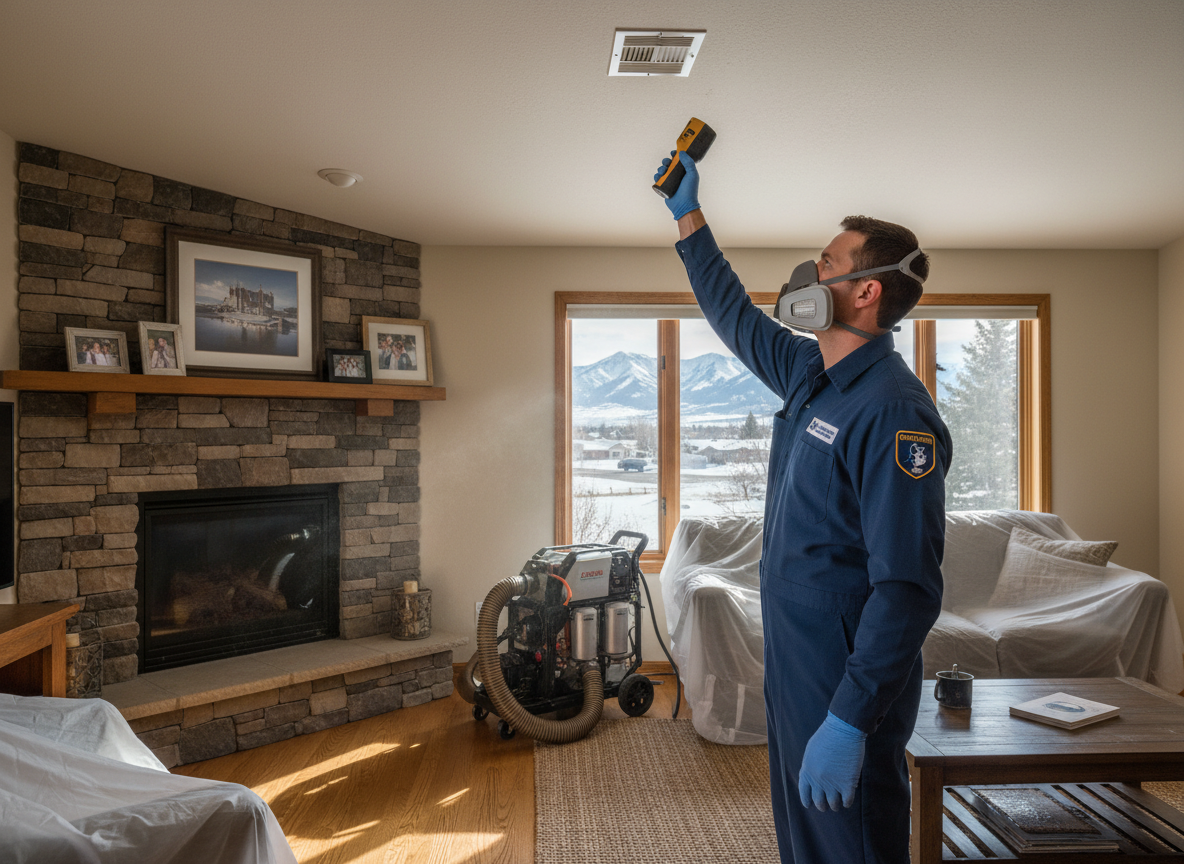
Holladay sits in a semi-arid climate where hot summers stir up fine dust and pollen that settles into ductwork, while cold snowy winters drive homeowners to seal homes tightly and run furnaces for months. This cycle concentrates particles in older single-family homes found throughout Holladay Village and near Mount Olympus. Properties built before 1980 often have rigid metal ducts with seams that collect debris over decades, especially in neighborhoods close to Olympus Hills Park where tree cover adds extra organic matter. Proper cleaning requires accessing these systems without disturbing insulation or creating negative pressure that pulls attic dust downward.
Many homes in Cottonwood and adjacent Millcreek pockets sit on sloped lots that create uneven airflow and cold spots where condensation forms inside ducts during winter. Salt Lake County’s inversion layers trap pollutants close to the ground, making regular source removal more important than simple filter changes. Technicians must map each run, remove registers carefully to avoid damaging original plaster or tile, and use HEPA filtration during extraction to keep fine silica and road salt residue from recirculating. Skipping these steps leaves behind the very contaminants residents notice as persistent odors after the first cold snap.
Service calls in Holladay frequently involve two-story homes where second-floor returns pull air from crawl spaces that stay damp even in dry summers. Addressing this means isolating those returns, cleaning the main trunk lines that run through unconditioned attics, and verifying balanced airflow afterward so the furnace does not short-cycle during January freezes. Local crews learn quickly that skipping the return-side cleaning in Mount Olympus homes leads to repeat calls once snowmelt raises humidity levels again.
Technician insight
In Holladay the thing that catches most people out with indoor air quality services is how cold snowy winters push fine road salt and silica dust deep into return ducts of older Mount Olympus homes; once the furnace starts pulling hard in January, that material moves into living spaces unless the returns are cleaned from the far ends first.
Persistent Dust After Inversion
A Cottonwood homeowner noticed fine gray dust settling on surfaces within days of each inversion. Inspection showed the main return in the unconditioned attic had never been cleaned and was pulling attic insulation fibers. The crew isolated the return, cleaned the full trunk line and branches, then verified airflow balance. The homeowner reported no visible dust for the rest of the heating season.
How it works
- 1
Initial Assessment
Walk through the home in Holladay Village or Mount Olympus to locate all supply and return runs, note duct material, and identify moisture or pest evidence before any equipment enters the space.
- 2
System Isolation
Seal off registers and returns with protective coverings, set up negative-pressure HEPA units at the main trunk to contain dust during cleaning.
- 3
Source Removal
Use rotary brushes and compressed-air whips sized for rigid metal ducts common in pre-1980 Holladay homes, progressing from farthest runs back to the furnace.
- 4
Post-Cleaning Verification
Reassemble registers, run the system, and check airflow at each vent to confirm balanced delivery before leaving the property.
Pricing
Cost depends on number of runs, home stories, and access difficulty; request an on-site assessment for an upfront quote.