Holladay sits in a semi-arid climate where hot summers pull fine dust into homes and cold snowy winters force furnaces to run for months. This cycle packs pollen, road salt residue and mountain dust into ductwork, especially in single-story ranches and two-story homes built in the 1960s through 1980s around Holladay Village and Mount Olympus. Older flex duct and metal trunk lines common in these neighborhoods trap debris that standard filters miss, reducing airflow and circulating irritants once heating season begins.
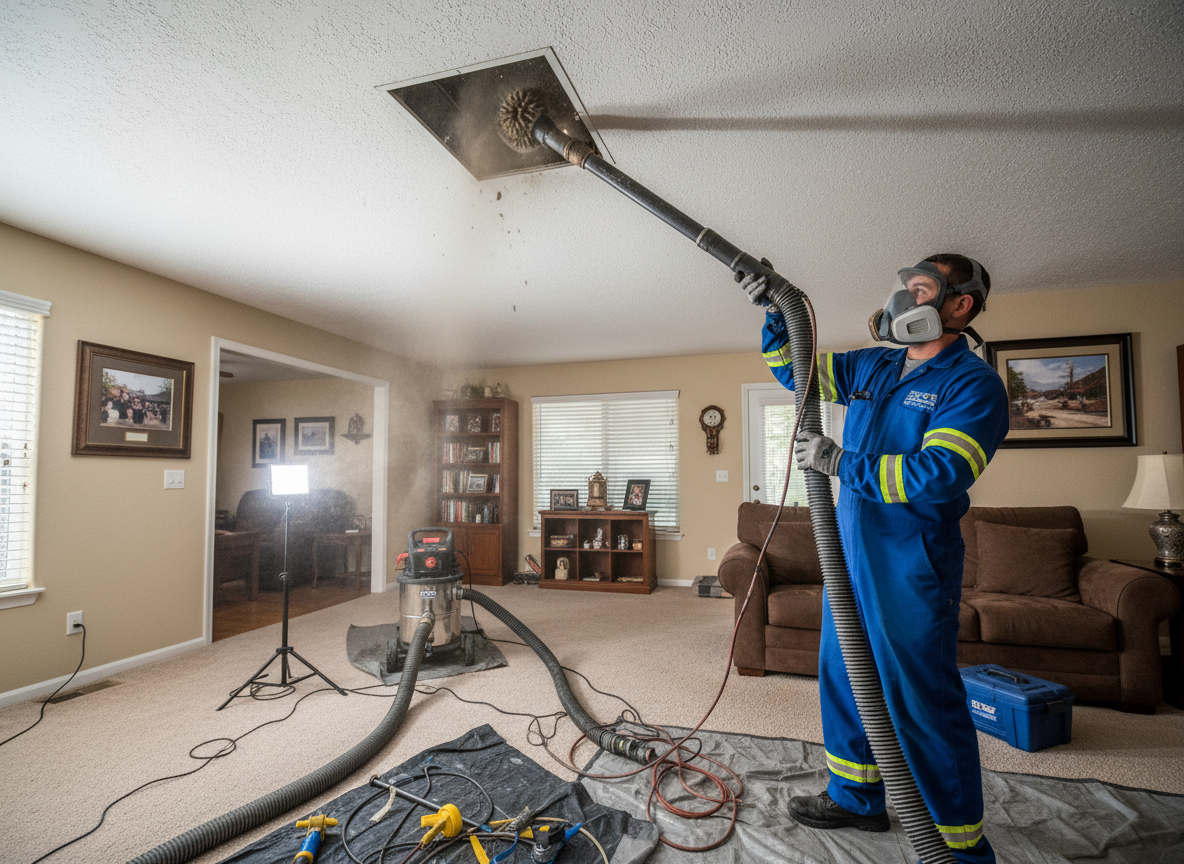
Technicians working from 5025 Highland Dr see the same pattern in Cottonwood and nearby Millcreek properties: supply runs that drop through finished ceilings often contain construction debris left from renovations, while return plenums near crawl spaces collect rodent hair and insulation fibers after winter storms. Negative-pressure equipment with HEPA filtration is required to prevent redistribution; brushing alone without capture leaves particles suspended. Homes near Olympus Hills Park and Holladay City Park also face extra pollen load from mature trees that homeowners notice most after the first furnace cycle in October.
Proper cleaning accounts for register placement, trunk line access points and the limited attic space typical in Holladay's older stock. Skipping sections behind finished walls or failing to seal the system before starting can push contaminants into living areas. Crews verify each branch run reaches the main trunk and confirm static pressure returns to normal before leaving the job, a step that prevents callbacks when winter temperatures drop and systems run continuously.
Technician insight
In Holladay, the thing that catches most people out with professional air duct cleaning is how decades-old flex duct in Mount Olympus homes collapses under vacuum if you do not brace the runs first, especially after heavy winter furnace use packs fine dust into every seam.
Reduced airflow in a Cottonwood home
A family near Cottonwood noticed weak heat on the second floor after the first cold snap. Inspection showed compacted dust and pollen blocking flex runs installed in the 1970s. We sealed the system, agitated the trunk lines, and extracted material through the main return. Airflow returned to normal and the homeowners reported steadier temperatures through the rest of winter.
How it works
- 1
Initial System Inspection
Technicians map every supply and return run, note duct material and access points, and check for moisture or pest evidence in homes throughout Holladay Village and Mount Olympus.
- 2
Register and Vent Sealing
All registers are removed and openings sealed to create a closed negative-pressure loop before agitation begins, preventing dust from escaping into living spaces.
- 3
Agitation and Extraction
Rotating brushes and compressed air tools dislodge debris while a truck-mounted vacuum pulls material through the main trunk lines to HEPA filtration.
- 4
Final Verification
Each branch is inspected with a camera, static pressure is measured, and registers are reinstalled before the system is returned to normal operation.
Pricing
Cost depends on number of runs, access difficulty and whether the home has flex duct or older metal trunk lines common in Holladay.