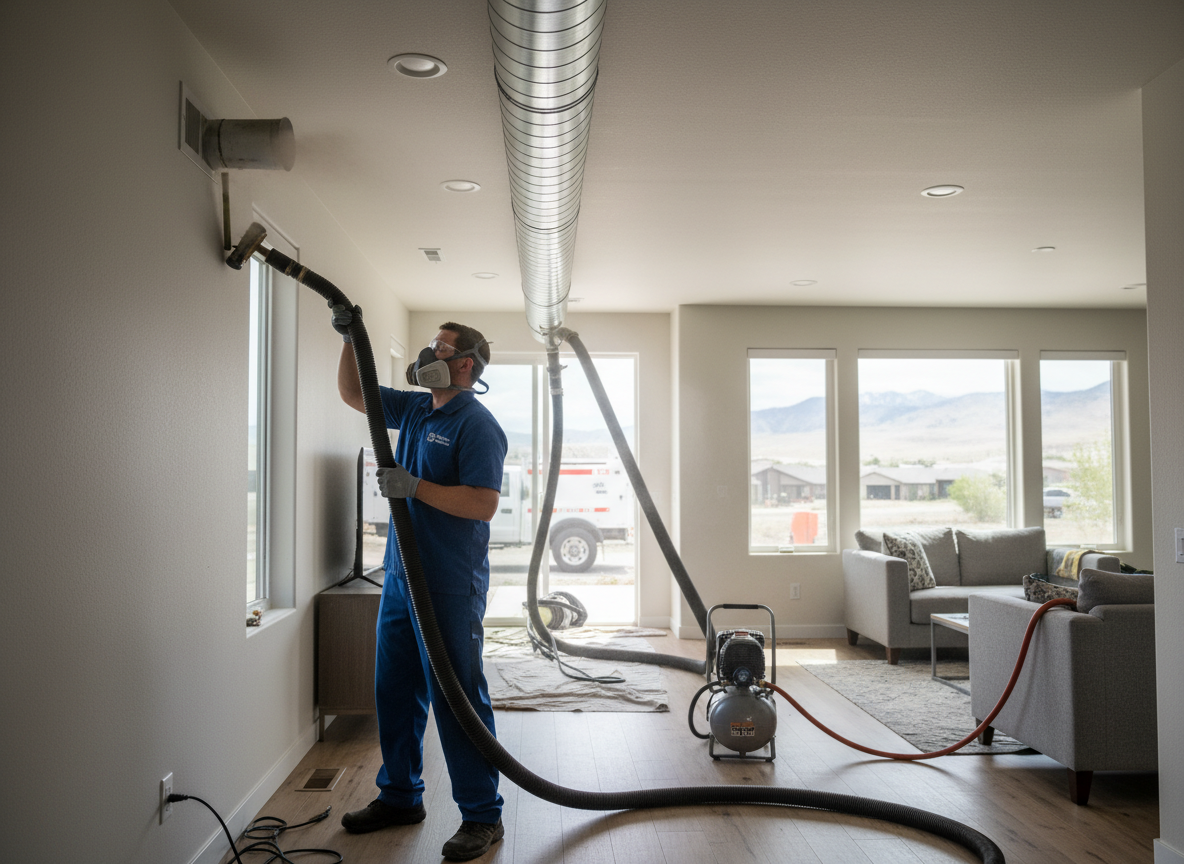
Holladay homes built from the 1950s through the 1980s often have rigid metal trunk lines that run through crawl spaces or unfinished basements. These ducts collect fine dust and pollen pushed in during the long snowy winters when windows stay closed. A full whole-house cleaning reaches every branch run, including the short flex lines that feed bedrooms in Mount Olympus and Cottonwood neighborhoods. Skipping the return plenum or failing to seal the system before vacuuming simply moves dust from one room to another.
Summer brings its own issues. Hot, dry air from the valley pulls fine soil through any unsealed joints, especially in single-story ranch homes near Holladay City Park. We use negative-air machines sized for the square footage and inspect each boot for gaps that let debris re-enter after cleaning. Homeowners in Millcreek and Cottonwood Heights who skip this step often call back within a season because the same dust reappears on registers.
Access matters on Salt Lake County’s sloped lots. Properties near Olympus Hills Park frequently have duct runs that turn sharply under additions, requiring sectional rods rather than straight whips. We map every run before starting so no section is missed, then finish with a visual camera check to confirm the metal is clear and the seals are intact.
Technician insight
In Holladay the thing that catches most people out with whole house air duct cleaning is the sharp 90-degree turns under 1960s additions near Holladay Village. Those tight elbows trap heavy dust that standard whips miss, and the only way to clear them is sectional rods fed from the trunk. Homeowners who skip that step usually see dust reappear on the registers within two weeks of the first cold snap.
Mount Olympus Ranch With Blocked Returns
The homeowner noticed weak airflow from bedrooms added in the 1970s. We found the return line under the addition packed with fine soil and insulation fibers. After isolating the system and running sectional rods through the tight elbow, the vacuum pulled out several pounds of debris. Airflow returned to normal and the family reported the furnace no longer short-cycled on cold nights.
How it works
- 1
Initial Walk-Through
We inspect every register, return, and the furnace or air-handler cabinet while noting home age and recent renovations.
- 2
System Isolation
Registers are masked and the system is placed under negative pressure so debris cannot escape into living spaces.
- 3
Mechanical Agitation
Rotating brushes and compressed-air whips loosen debris from rigid and flex duct walls without damaging seams.
- 4
Vacuum Extraction
High-volume negative-air equipment pulls loosened material out through the main trunk and into sealed collection containers.
- 5
Final Camera Verification
We run a camera through main lines to confirm all sections are clear before removing isolation materials.
Pricing
Cost depends on number of runs, access difficulty, and whether flex duct replacement is needed; we provide an upfront quote after the walk-through.